
Your August Maintenance List Has Legal Clocks: Hose Checks After Every Unloading, and More
Operations / Maintenance
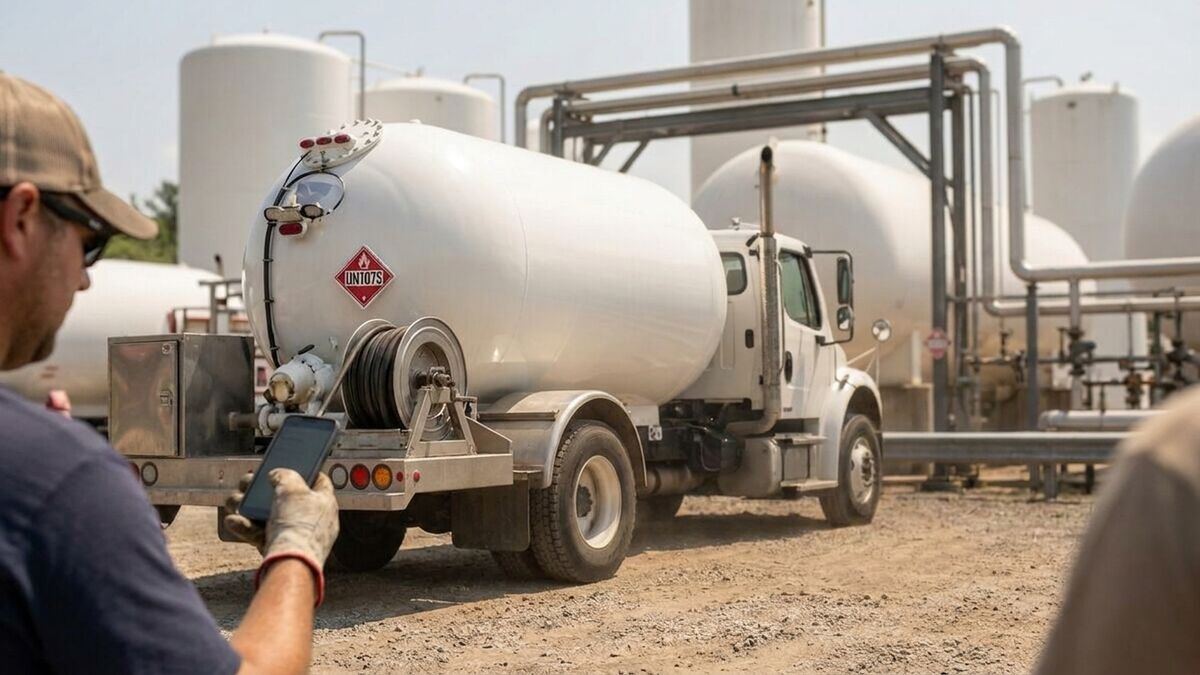
Federal hose rules, NFPA 58 valve and cathodic intervals, and manufacturer regulator life all carry fixed clocks. August is the last month with slack to work them before heating season closes the window.
The Situation
FROM OUR TOOLBOX — PROPANE INSIDER
Code says a delivery hose gets looked at before every use, and a cracked one comes off the truck that day (NFPA 58, Chapter 7). Tank Spotter puts the monthly hose check on each driver's phone and files the sign-off on the spot — no clipboard, no lost sheet. Nothing to dig for when an inspector asks. Operators are moving this paperwork to phones to hold down operating costs — see how it works at tankspotter.com.
The Facts
Tank paint and rust are a pressure item
NFPA 58 calls for LP containers to be painted a heat-reflective light color — white, light gray, silver. The reason is physics. Dark paint absorbs solar radiation, raises the liquid temperature, and pushes internal pressure toward the relief-valve setting. Rust works the same way twice over: it is a dark surface, and it pits steel until structural integrity is in question, per Propane101's guidance on tank color. Writing in Butane-Propane News in June 2022, Andy Daughtrey put reconditioning in the summer window — sandblast aged tanks, repaint, swap weathered valves while the tank is already down. The clock on this one is the calendar, and the calendar is short.
Prep matters more than the topcoat. Remove the rust, prime with a rust-inhibiting metal primer, finish light. Never paint the data plate, relief valve, regulator, connections, or manufacturer labels — Ferrellgas and Aero Energy both warn that an unreadable data plate can make a tank unfillable, and a repaint that buries the stamped information costs far more than the paint job saved.
Delivery hoses: three clocks inside one rule
49 CFR 180.416 governs hose on MC-330 and MC-331 cargo tanks in propane service, and it sets three separate intervals. After every unloading, the driver visually checks the deployed portion of the hose. Monthly, each hose assembly in service gets a visual inspection, plus a piping-system look at fusible elements, bolts, connections and seals and a leakage check of the internal self-closing stop valve — a meter creep test is acceptable on metered trucks. Annually, hoses not permanently attached get a leakage test. New and repaired assemblies are tested at 120% or more of maximum working pressure, then marked with the month and year.
The paperwork is part of the rule. Each inspection is recorded with date, inspector, hose ID, manufacturer, assembly or test date and result, and that record is kept until the next test of the same type passes. Every hose carries a permanent unique ID and its maximum working pressure. Rejection criteria are spelled out: damaged reinforcement, loose or missing or corroded bolts, stop valves that won't actuate, damaged stainless braid, detectable internal-valve leaks, severely corroded pipe.
Reels wear on their own schedule: lubricate the bearings and replace them at the first grinding, squeal or vibration; replace chain and sprockets on power-rewind reels at the first sign of rust or slack; and check spring tension and mounting bolts while the truck is already down.
Bulk plant: annual, and never more than 36 months
Emergency shutoff valves and remote-closure internal valves are tested annually under NFPA 58. Placement is part of the check — an ESV within 20 feet of lineal pipe from the hose or swivel end, thermal elements within 5 feet. Cathodic protection on underground tanks runs the longer clock, a slower cadence that easily outlasts staff turnover: per Butane-Propane News' cathodic-protection explainer, test at installation, again 12 to 18 months later, then at intervals no longer than 36 months, with a pass at −0.85 VDC or more negative against a copper-copper sulfate half cell. NFPA 58 gives a failed system 180 days for repair when conditions delay the work, and documentation of the two most recent tests stays on file. A volt meter and a half cell do the job.
Florida's state bulk-plant inspection checklist reads as a usable field template: hose kinking and flattening, soft spots and bulges, weather cracking, exposed threads, pneumatic operation of the ESV.
Regulators run on the manufacturer's clock
RegO puts most post-1995 regulators at a 25-year service life and single-stage units at 15 years; Fisher lists 20 years on the R622H. Those are manufacturer numbers, not code figures. Operators who stay ahead of it track every customer regulator by anniversary date and replace the ones past service life — the age data is usually already sitting on GAS Check forms, waiting to be used.
Bobtails and meters
49 CFR 180.407 sets recurring external visual and leakage testing on DOT's cycle, with the pressure test at 1.5 times MAWP on a five-year cycle; dedicated LP MC-330 and MC-331 units may run the leakage test at 60 psig or above. Meter accuracy follows NIST Handbook 44, enforced by state weights and measures on each state's own proving schedule. There is no national interval.
Business Impact
Deferred maintenance turns into a fillable-gallons problem, and it lands three ways for a family-owned company. First, a tank with a painted-over or corroded data plate is a tank your driver cannot legally fill, so you are buying a replacement or eating a service call to a customer who is out of gas. Second, a hose pulled from service in January is a truck at reduced capacity during your highest-margin week, and the crew you'd pull to fix it is already on the road. Third, the 49 CFR 180.416 records are what a DOT inspector reads first, and a missing month is far easier to document in August than to explain later.
Key Takeaways
- 49 CFR 180.416 sets three separate hose intervals — after every unloading, monthly, and annually — so a single quarterly walkaround does not satisfy the rule.
- Every 180.416 inspection must be recorded with date, inspector, hose ID and result and kept until the next passing test, which makes the logbook, not the hose, the audit exposure.
- NFPA 58 puts emergency shutoff and remote-closure internal valves on an annual test, and the placement standard — 20 feet of lineal pipe, thermal elements within 5 feet — is checked alongside function.
- Cathodic protection on underground tanks runs at intervals no longer than 36 months, with 180 days to repair a failed system under NFPA 58 — a slow clock that is easy to lose track of.
- Regulator service life is a manufacturer number, 15 to 25 years depending on maker and type, so the replacement trigger lives in your customer records rather than in the code book.
Action Steps
- 1.Pull your hose inspection log this week and confirm every assembly in service shows an unbroken monthly record and a current annual leakage test under 49 CFR 180.416.
- 2.Verify each delivery hose carries its permanent unique ID and maximum working pressure marking, and that new or repaired assemblies show the month-and-year test mark.
- 3.Schedule the annual emergency shutoff and internal-valve test at the bulk plant before Labor Day, and check ESV and thermal-element placement while the tester is on site.
- 4.Date-check your last cathodic protection reading on every underground tank; anything approaching 36 months goes on this month's schedule, half cell in hand.
- 5.Sort your customer tank list by paint and rust condition and route the worst of it for sandblast-and-recoat now, masking the data plate, relief valve, regulator and connections.
- 6.Add regulator install date to your GAS Check capture so age lives in the customer file rather than in a technician's memory.
Competitive Advantage
Print the five clocks — after-every-unloading, monthly, annual hose test, annual ESV test, 36-month cathodic — on one page and hang it in the shop this week. The operators who get through heating season without a compliance scramble are the ones who worked the intervals while the trucks were still parked.
Which of these intervals is hardest to keep current at your company — the monthly hose check, the annual ESV, or the cathodic reading?
Get the next one in your inbox.
Free propane industry news, twice a week. 30,000+ operators already read it.
No spam, unsubscribe anytime. We'll email you a link to confirm — that's how we keep the list real. Cloudflare processes a short bot-check token on this form. See our privacy policy.
Published by PropaneInsider.com
AI-powered propane industry news for 30,000+ professionals
Propane Insider is published by the makers of Tank Spotter, Custom Fuel App, Blink Fuel, PIMS and Propane Safety Pro; some links go to advertisers.