
Get Your Stored Diesel’s Cloud Point From Your Supplier
Get Your Stored Diesel’s Cloud Point From Your Supplier
The Situation
One gelled bobtail can push a whole will-call route into tomorrow. Anytime Fuel Pros' Sep 5 additive guide says anti-gel treatment has to be in the fuel before wax crystals link together. So the additive has to be in your tank and mixed before overnight lows reach the fuel's cloud point.
Mills Equipment says to treat while nighttime lows are still comfortably above the cloud point of the fuel you store. For most northern operations, that means late September into early October. For milder regions, it may be November. Anytime Fuel Pros, citing Bell Performance, says to treat once the forecast low comes within about 10°F of the fuel's cloud point, because cloud point is a lab measurement. Start biodiesel blends earlier than straight #2 diesel.
Mills' northern window has passed. Check the forecast low at your storage site against your cloud point today. If the fuel already in storage may reach its cloud point, ask your supplier now for a treatment or recovery plan suited to that fuel and its current temperature; do not wait for the next fill. If forecast lows remain above that cushion, watch the forecast daily and arrange treatment before the gap closes. In a milder region, you may still be inside the window.
When you get the cloud point from your supplier, ask what's already in the fuel. Many suppliers switch to winter blends or pre-treat seasonally, on timing that varies by region and supplier. Ask your supplier whether the existing treatment is sufficient for the forecast and equipment before adding anything else. Anytime Fuel Pros also says to keep an emergency solvent or deicer on hand for roadside recovery and to stock spare filters before the first hard freeze. If fuel does gel, follow the equipment maker's recovery steps and use any emergency product only as its label directs.
The Facts
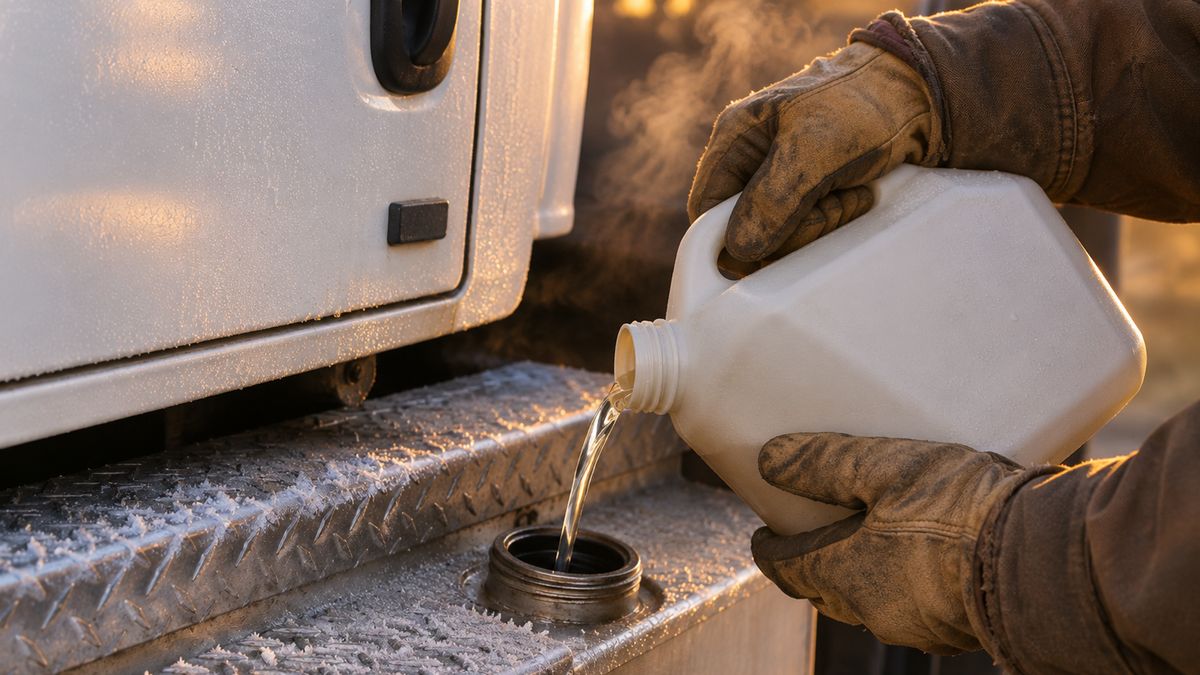
When your supplier confirms treatment is needed, follow the label-directed dose and mixing instructions. Mills Equipment says delivery-truck turbulence helps mix additive through the fuel. Pour additive into the top of a cold, still, mostly full tank and it mixes poorly and settles in a layer. That layer gets protection, but your suction tube may be drawing fuel from below it.
Cold-flow improvers won't fix two other winter problems. The first is water. Deicers go after water directly, and cold-flow improvers don't. A half-empty tank has more headspace for condensation, which is where water contamination starts. The second is DEF, which freezes at 12°F, according to Anytime Fuel Pros' Sep 21 delivery-planning guide. Keep totes and jugs out of unheated trailers overnight. If stored DEF does freeze, the fluid itself isn't damaged once it thaws. For the DEF system on the truck itself, follow the truck maker's manual.
Business Impact
Shrader Tire & Oil's Sep 30, 2026 winter checklist describes the damage as a chain: "It's a gelled fuel filter on Monday, a dead battery on Tuesday, and a late load by Wednesday." The checklist puts anti-gel fuel treatment and fresh filters first and says to finish before temperatures drop below freezing. For a propane retailer, that chain could end with a parked bobtail and a will-call customer waiting on a delivery dispatch had to move.
Action Steps
- 1.Now: Have your office manager get the stored fuel's cloud point from the supplier's spec sheet and ask whether its existing winter blend or treatment is sufficient for the forecast and equipment. Agree on any treatment or recovery needed before the cold arrives.
- 2.At the next bulk diesel delivery: If your supplier confirms treatment is needed, ask the supplier to add the label-directed dose at delivery, while the truck fills the tank.
- 3.This week: Have your yard lead move DEF totes and jugs out of any unheated trailer.
Competitive Advantage
Keep any heated storage or heated lines your site already uses.
Who will call your supplier today to confirm that the diesel already in storage is ready for the forecast low?
Get the next one in your inbox.
Free propane industry news, twice a week. 30,000+ operators already read it.
No spam, unsubscribe anytime. We'll email you a link to confirm — that's how we keep the list real. Cloudflare processes a short bot-check token on this form. See our privacy policy.
Published by PropaneInsider.com
AI-powered propane industry news for 30,000+ professionals
Propane Insider is published by the makers of Tank Spotter, Custom Fuel App, Blink Fuel, PIMS and Propane Safety Pro; some links go to advertisers.