
The Written Procedure Said Disarm Early. The Equipment Maker's Manual Said the Opposite.
A $450,000 lesson: the written procedure said disarm early. The equipment maker's manual said the opposite.
The Facts
A thumb landed on the wrong button of a remote-control handset, and seconds later liquid propane was leaving a loading arm at pressure. The UK Health and Safety Executive's May 27, 2026 enforcement release puts the root of that release earlier than the button: HSE investigators established that the site operator's own written operating procedure required the emergency release coupling to be disarmed before the loading arm had been fully purged and drained, an instruction that, in HSE's words, "directly contradicted the guidance provided by the loading arm manufacturer" and also contradicted procedures prepared by the third party that installed the equipment.
The release happened at Shell's Braefoot Bay Marine Terminal near Dalgety Bay, Fife, in the early hours of 1 November 2018. Per the same HSE release, a gas engineer aboard the tanker MV Symi took cold burns to 10 to 13 percent of his body surface, and Shell UK was fined 450,000 pounds. A marine terminal on the Firth of Forth sits a long way from a bulk plant in Ohio. The coupling, the liquid trapped in the line, and the order of the shutdown steps are all things an American service tech handles on an ordinary Wednesday.
What HSE says actually went wrong
HSE's May 27, 2026 release describes the trigger this way: a Shell technician accidentally pressed a button on a remote-control handset, causing a loading arm quick release coupling to disconnect from the ship's manifold before the arm had been fully cleared of propane. HSE puts the volume at an estimated 250 to 300 kilograms of liquid propane, released at pressure in a matter of seconds, creating a flammable vapour cloud that enveloped workers on the ship's deck and the adjacent jetty.
Then comes the finding in that HSE release that ought to stop a shop foreman mid-sentence. Three documents governed one disconnect. The manufacturer's guidance and the installer's procedures agreed with each other. The company procedure the crew actually followed, HSE found, told them to disarm a critical safety mechanism early.
The window nobody drew on the diagram
Disarming a release coupling before the line is empty creates a period, measured in seconds or minutes depending on the job, when a single unintended input can dump product. HSE identified two significant underlying failings, and the first was that Shell's system of work was unsafe: per HSE, the operating procedure required workers to disarm the emergency release coupling too early in the disconnect sequence, before the loading arm was fully cleared.
Nobody wrote that window into the procedure on purpose. It appeared in the gap between a step that made sense on one piece of equipment and a step performed on another. Ask any tech who moved from an older bulk plant to a rebuilt one what changed about the shutdown order, and you will usually get a shrug and a version somebody demonstrated once, on a Tuesday, four years ago.
Small operators run the same sequence at lower volume
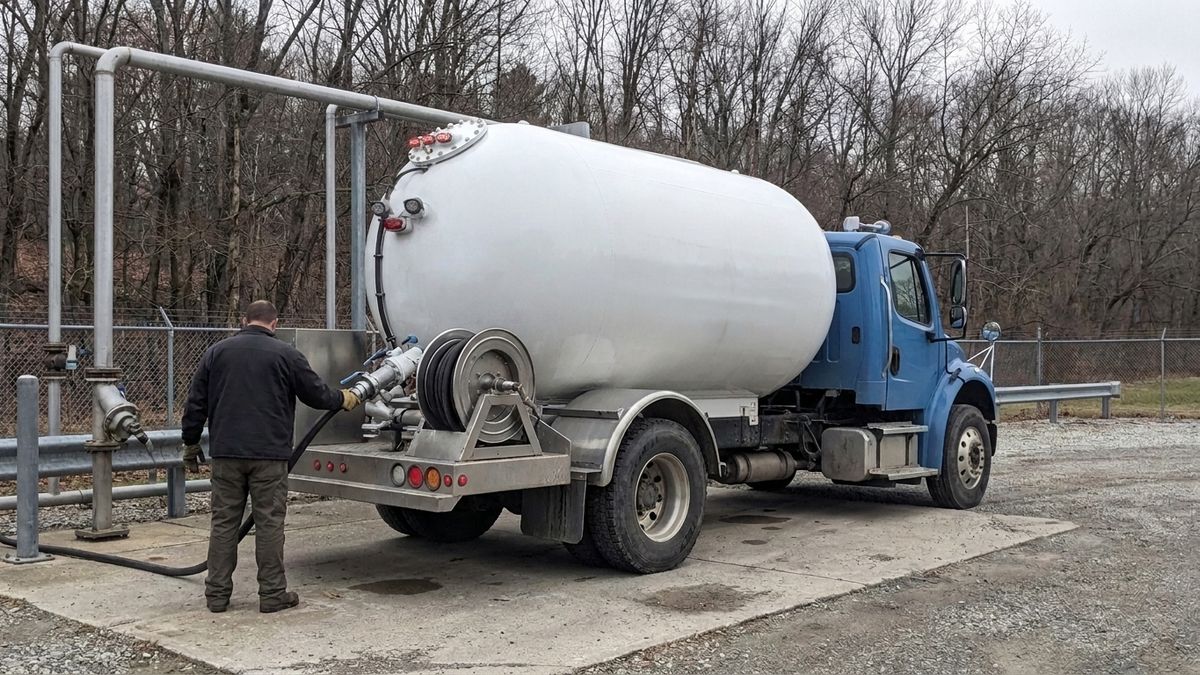
A bobtail loading rack, a transport unloading into a storage bullet, a hose disconnect after a 1,000-gallon domestic fill: same physics, smaller numbers. Liquid stays in the line between the last valve and the coupling. What the crew does about that residual liquid, and in what order, is a written step somewhere, and that written step either matches the hardware standing in front of the tech or it does not.
No corroded fitting or cheap valve appears anywhere in the HSE account. The equipment behaved as designed, including the quick release coupling, which released quickly. The sequence somebody typed up is what failed.
What a tech can check without waiting for a policy review
HSE's second underlying failing was management of change: when Shell replaced all four marine loading arms in 2018 with equipment from a different manufacturer, HSE found the company treated the project as a straightforward like-for-like replacement when it was not. Any plant that has swapped transfer equipment in the last several years has run the same risk, at smaller scale. Edited procedures inherit assumptions from equipment that is no longer on the pad.
The crown accepted, per HSE, that the probability of ignition sat between one and two percent, and HSE noted the results of such an ignition could have proven catastrophic. Both are true at the same time, which is exactly why procedure drift earns an afternoon of somebody's attention. Long odds do not shrink the consequence. They only change how long a crew gets away with the gap.
Do this before the end of the week
Manufacturer literature has a way of ending up in a drawer in the parts room, or in an email thread with a rep who has since retired. At Braefoot Bay, by HSE's account, that literature held the right answer the whole time while the procedure in the crew's hands held a different one.
So pull your transfer and disconnect procedures this week, put them next to the manufacturer's manual and any commissioning document for the coupling, arm, or hose assembly actually in service, and answer three questions in writing: 1) Does any step in your procedure contradict the manual, especially on when a release or breakaway coupling gets disarmed relative to purge and drain? 2) Who signed off on that procedure, and when was it last reviewed against the hardware now on the pad? 3) Do the people doing the job know which document wins when the two disagree, and can they name it without looking? Then get the answers back to whoever owns the procedure, with a date on them. Put both documents on the same table before an inspector does it for you.
Business Impact
Reconciling written transfer procedures against manufacturer documentation costs a few hours of a service manager's time. A single unintended product release during transfer puts a worker in a burn unit, takes a loading rack or a plant out of service through an investigation, and hands a regulator a documented gap between what the equipment maker specified and what the company told its crews to do. Per HSE's May 27, 2026 enforcement release, Shell UK was fined 450,000 pounds over the Braefoot Bay release; the operational, insurance, and reputational exposure facing a small marketer after a comparable release is not proportionally smaller.
Action Steps
- 1.Pull your transfer and disconnect procedures this week and set them beside the manufacturer's manual.
- 2.Check for any step that contradicts the manual, and write down who signed it off and when it was last reviewed.
- 3.Ask your crew which document wins when the two disagree, and route the answers, dated, to the procedure owner.
When your written transfer procedure and the equipment manufacturer's manual disagree, who at your company decides which one the crew follows, and is that decision written down anywhere?
Get the next one in your inbox.
Free propane industry news, twice a week. 30,000+ operators already read it.
No spam, unsubscribe anytime. We'll email you a link to confirm — that's how we keep the list real. Cloudflare processes a short bot-check token on this form. See our privacy policy.
Published by PropaneInsider.com
AI-powered propane industry news for 30,000+ professionals
Propane Insider is published by the makers of Tank Spotter, Custom Fuel App, Blink Fuel, PIMS and Propane Safety Pro; some links go to advertisers.