
Gulf Coast export capacity has become one of the most influential structural forces in U.S. propane markets. Over the past decade, incremental dock expansions, refrigeration upgrades, and new VLGC loading capabilities have increased the system’s ability to move barrels offshore at scale. For inland marketers, this is not an abstract macro trend. Strong export pull alters storage economics, rail and pipeline flows, forward pricing behavior, and even lender and insurer expectations. When terminals run hard, supply psychology changes long before physical shortages appear. The operational consequences show up in contract structure, dispatch timing, and winter risk tolerance.
Export Throughput Changes the Market’s Risk Posture
U.S. propane production continues to exceed domestic demand, and exports now routinely absorb a large share of total supply. The structural shift is not simply about volume; it is about priority. Export terminals operate on long-term contracts with global buyers, and once refrigerated storage and dock slots are committed, barrels tend to move.
Inland marketers often assume that high national inventories translate into regional comfort. That assumption weakens when Gulf Coast capacity expands. When export terminals demonstrate the ability to consistently load near nameplate capacity, the market builds in a stronger floor under Mont Belvieu pricing. Traders respond early. Financial hedges reprice before physical inventory tightens in the Midwest or Northeast.
This is where “supply psychology” becomes operationally relevant. Even with healthy EIA-reported stocks, forward curves can invert quickly if traders anticipate export strength through peak winter months. Inland marketers who rely on spot purchasing or short-term rack positions may face tighter basis spreads and more volatile replacement costs — even if tanks appear adequate locally.
Basis Risk and the Inland Cost Structure
For inland marketers, the real exposure is not just the Mont Belvieu flat price; it is the basis between the hub and regional terminals. As the Gulf Coast export pull strengthens, pipeline and rail flows increasingly align with the most profitable outlet.
Midcontinent and Upper Midwest operators have seen this pattern before. When Gulf docks load aggressively, upstream barrels tend to move south. Regional terminals must compete more actively, and the basis can widen. That directly affects the margin if customer pricing programs lag replacement cost.
Insurance underwriters and lenders are paying closer attention to this volatility. Credit facilities that once assumed stable winter spreads now scrutinize storage levels, hedging ratios, and supply diversity. Export strength introduces structural tightness risk that must be managed, not dismissed.
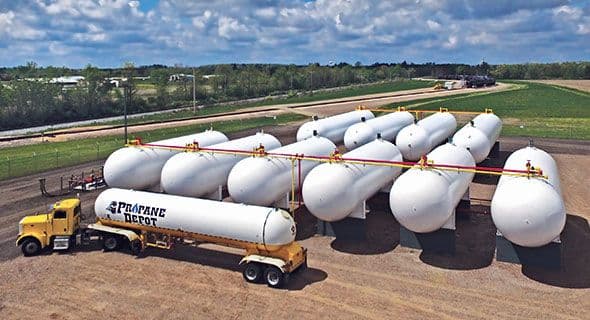
Operationally, this shifts the calculus on storage. Larger on-site bulk capacity is no longer just a service differentiator; it is a financial buffer. Operators with limited bulk storage become more exposed to rack swings during peak export windows.
Transportation, Dispatch, and Contingency Planning
Export expansions also stress shared infrastructure. Pipelines feeding Gulf terminals compete for line space during strong global demand periods. Railcars that might otherwise reposition inland can become tied up in coastal logistics cycles.
Inland dispatch teams feel this in subtle ways: longer replenishment lead times, more rigid terminal allocations, and occasional lift restrictions during extreme weather events. The physical system may not be short of propane, but the timing and routing of barrels become less forgiving.