
What the Midterm Elections Mean for Propane
Midterm Propane Impact: state risks and the heat-cost math
The Facts
WHAT THIS MEANS FOR YOUR BUSINESS
- A new Congress changes where to press your case. In this November 4 snapshot, NBC projects Democratic control of both chambers. Ask your trade group to put heating aid and fuel choice in front of the incoming members. Include fleet needs.
- Propane has a heat-cost case, with limits. It beats resistance heat in eight of our nine state examples. But a COP 3 heat pump is cheaper to run in all nine. These states were picked for a quick check, not sampled. A customer's savings estimate depends on the heat pump, rates and weather.
- Winter aid is a payment task you can work on now. Federal money has been released. Your staff can check vendor enrollment and help eligible households with the state application process.
- Keep hoped-for credits and grants out of guaranteed savings. The IRS lists the alternative fuel credit as expired. REAP grants have new project-data requirements. Price the proposal on the program terms that apply to that customer.
THE NEW MAP
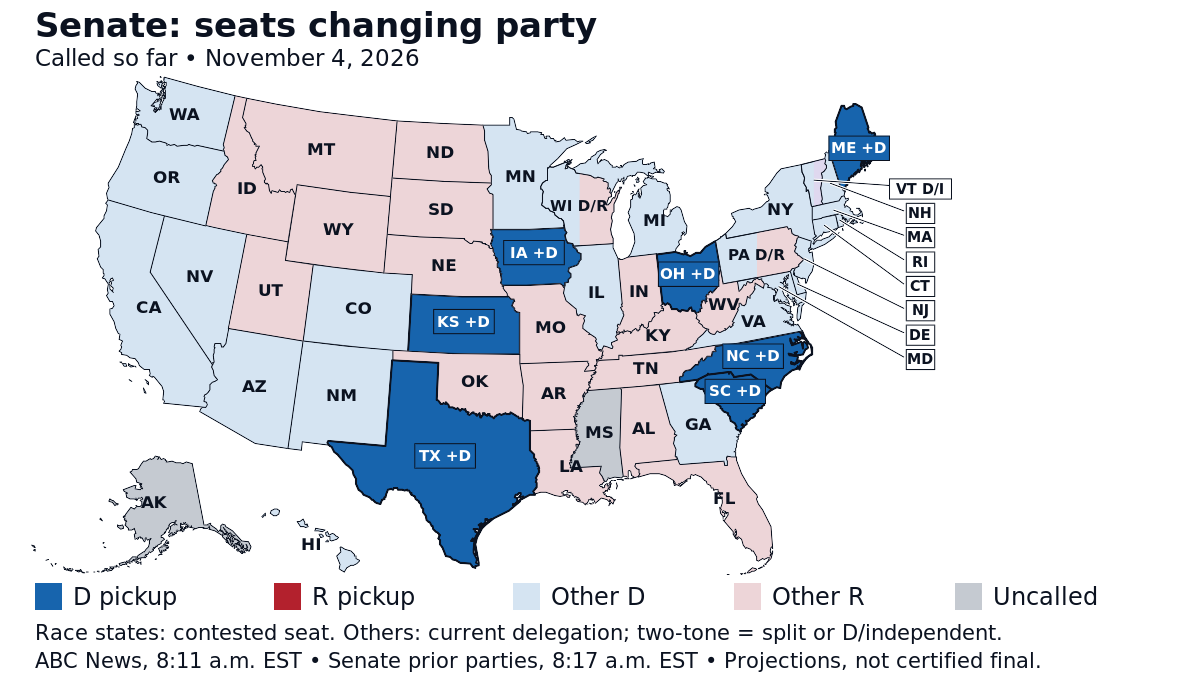
Snapshot captured Wednesday, November 4, 8:11–8:17 a.m. EST. These are uncertified news-desk tallies. The totals include continuing seats; individual race entries below distinguish leads from calls.
Democrats have picked up five governorships and seven Senate seats in the calls so far, with no Republican pickups called in those offices.
For your territory, check the state rules below before you bid or set a project schedule.
The Democratic governor pickups are Georgia, Iowa, Nevada, Ohio and Texas. The ABC and NBC calls assembled for these maps name those pickups.
The Democratic Senate pickups are Iowa, Kansas, Maine, North Carolina, Ohio, South Carolina and Texas. The same desks name those pickups.
| Next composition, desk tallies plus continuing seats | Democrats | Republicans | Independents | Uncalled | |---|---:|---:|---:|---:| | House | 231 | 144 | 0 | 60 | | Senate | 52 | 44 | 2 | 2 | | Congress total | 283 | 188 | 2 | 62 | | Governors | 28 | 20 | 0 | 2 |
Sources: NBC House calls, ABC Senate calls and ABC governor calls. The governor row is ABC's count. ABC marks only Alaska and Kansas as still leading. Neither source we read names a projected winner in Maryland or New York.
Alaska and Kansas governor races were uncalled in this snapshot. So were Alaska and Mississippi Senate races. These counts do not establish control of any state legislature.
IF YOU SELL IN THESE STATES
Maryland: possible supplier duties and equipment pressure
Wednesday snapshot: Democrat Wes Moore was leading in NBC's uncertified captured results. Reporting was at 78.3 percent. The heat rules remain under development.
On the record: Maryland's Department of the Environment is developing two standards. They are a Clean Heat Standard and a separate heating-equipment standard. MDE describes the two standards as part of a transition to efficient heating solutions.
The equipment standard is under development. It concerns newly manufactured residential furnaces and boilers. It also covers newly manufactured residential water heaters.
Existing heating systems can remain in use. Cooking equipment is outside the standard's scope.
Possible effect: A final supplier standard could add compliance work or costs. Equipment limits could reduce future heating sales. Both depend on the final rules.
Do now / who to call: Contact the MDE Clean Heat Rules team. Ask which duties under consideration would apply to your business. Have your state propane association review how the agency treats delivered fuel and replacement equipment. Do this before you make long-term promises.
New York: a suspended restriction still matters to new-build bids
Democrat Kathy Hochul was also ahead in the same uncertified NBC capture. Reporting was at 87.6 percent.
The Department of State posted a July 2 update. It says the specified new-building fossil-fuel restrictions are suspended by court order. While suspended, they are neither effective nor enforceable.
The Assembly's explanation describes the law's new-construction scope. These requirements do not apply to existing buildings. If the suspension ends, restrictions affecting propane in covered new construction could again limit bids.
Give the local building-code office the project details. Request the current requirements in writing. Ask your state propane association for the next court or rule milestone. Do this before you order equipment for an affected project.
Texas: data-center approvals come before backup work
Democrat Gina Hinojosa won the governor's race in the map desks' calls. She is projected to succeed Republican Greg Abbott. We have not established her position on the existing permit directive.
Abbott's signed September 21 directive ordered a pause in data-center permits and further state regulatory approvals. The pause awaits information on grid reliability, security and water use. It directs the environmental agency, TCEQ.
It cites his earlier orders on the same issues. Those orders went to the utility regulator, grid operator and water board.
A project's approvals could delay generator and fuel work. That includes a propane opportunity where the equipment and project fit. Ask the project developer and Texas Commission on Environmental Quality about the specific approval and schedule. Keep unapproved projects out of firm installation commitments.
ELECTRICITY AND PROPANE
Our view: Growing power demand could help keep retail electricity costly. That could give propane a fair shot as heat and as backup fuel. That is a reason to sharpen the quote and build generator-installer ties. Rates and propane sales will depend on supply, costs and the projects that go ahead.
The EIA's October outlook forecasts 2027 electricity demand growth of 2.8% in the commercial sector. That sector includes data centers. The forecast for industry is 2.7%.
In its July auction report, grid operator PJM described its forward capacity auction for 2028–29. It said the auction cleared at the price cap. That is pressure in one capacity market.
Wholesale power may get cheaper: EIA expects lower wholesale prices in 2027. But wholesale power is only one part of a household bill.
The bill also carries transmission and distribution costs. So wholesale prices and household bills can move in different directions. Customer rates depend on more than demand growth.
The political record is mixed. Democrat Hochul paused discretionary environmental permits for new hyperscale data centers. The pause is for up to a year. Republican Abbott issued the Texas directive described above.
For a bid, check the order's scope and the affected project. Those matter more than the leader's party label.
Backup power is worth a separate sales conversation. In its October 28 results, Generac reported on its third-quarter shipments of home-standby and portable generators. They were higher than a year earlier. The report covers that manufacturer's shipments across generator fuels.
Our view: A dealer and qualified installer can quote equipment, fuel storage and service together. That applies where a propane-fueled system fits. Do not count a data-center generator order as propane volume without knowing its fuel.
For backup power, use a working CO alarm. Place the generator outdoors. Have a qualified installer handle the installation.
Compare the heat delivered to the house
The propane furnace beats resistance heat in eight of the nine states in the table below. Florida is the exception.
At COP 1.5, propane wins in five of the six Northeast and Midwest examples. Connecticut is the exception. Propane loses in all three Southern examples.
This table uses EIA's October 26, 2026 weekly residential propane averages, excluding taxes. It uses EIA's August 2026 residential electricity averages, released October 23. The dates differ.
Use the customer's tariff and your own quote for a bid. The table shows which option costs less to run per unit of heat. For dollars, run your own quote through the formula below.
Assumptions: a 95%-efficient propane furnace and 100% resistance heat. For heat pumps, assume COP 1.5 or COP 3. COP is heat delivered divided by electricity used. Those two COPs are examples, not promises about a particular unit or temperature.
Use EIA's conversion figures, with propane rounded to 91,500 Btu per gallon. A gallon delivers 91,500 × 0.95 Btu of heat. In millions, that is 0.086925.
For your own quote, divide your propane cost per gallon by 0.086925. That gives your cost per million Btu of heat.
One kWh is 3,412 Btu. For resistance-heat cost, divide the electricity price in dollars/kWh by 0.003412. Divide that result by the heat pump's COP.
EIA's more precise propane factor is 91,452 Btu. The rounding changes costs by less than 0.1%.
Which costs less per unit of heat (fuel and electricity only):
| State | Propane furnace vs. resistance heat | Propane furnace vs. heat pump, COP 1.5 | Propane furnace vs. heat pump, COP 3 | |---|---|---|---| | Connecticut | Propane | Heat pump | Heat pump | | Massachusetts | Propane | Propane | Heat pump | | New York | Propane | Propane | Heat pump | | Illinois | Propane | Propane | Heat pump | | Michigan | Propane | Propane | Heat pump | | Wisconsin | Propane | Propane | Heat pump | | Florida | Resistance heat | Heat pump | Heat pump | | Georgia | Propane | Heat pump | Heat pump | | North Carolina | Propane | Heat pump | Heat pump |
Sources: EIA residential propane and EIA residential electricity, Table 5.6.A; calculations as shown above.
At COP 3, the heat pump wins in all nine. We picked these nine states for a quick check. They do not represent the country.
Equipment and installation can change the answer. So can maintenance, local charges and the heat pump's actual performance.
Put the customer's rates and equipment into the same calculation before you offer a cost comparison. Keep the case for backup power separate. Do not claim that propane always supplies the cheapest heat.
THE BIGGER WRITE-UP
Put the next Congress to work on your business's bills
NBC News projected that Democrats had won control of both chambers of Congress. That followed Tuesday's U.S. midterms. The projection came Wednesday.
For propane marketers, turn heating-aid payments and fleet rules into a short list. Add tax questions and farm-project bids. Bring that list to the people who will represent you.
The result changes who will shape the next round of bills. Tax credits, grants and driver authority each follow their own rules.
The House's guide to making law sets out the passage and presidential approval or veto process. Plan around the rules in force while you press for changes.
Get winter-aid paperwork moving
The federal LIHEAP Clearinghouse reported a release of about $3.6 billion for fiscal 2027. The release was on October 9. Households still have to qualify through their state process.
Start with the state's current application process and your vendor standing. Check the documents needed to apply a payment to an account.
Pennsylvania offers a concrete example. Its Department of Human Services lists the season as November 2, 2026, through April 23, 2027. It says cash assistance goes directly to the utility or fuel provider for the household's bill.
Put those instructions in the hands of the staff member who handles aid accounts. Help customers find the right office without telling them approval is certain.
There is also a funding date to watch in Washington. The enacted stopgap law runs through December 11, 2026, unless superseded sooner. That is a deadline for the funding fight.
Ask your association to track the next measure. Keep account decisions tied to the state's award and payment rules.
Keep tax and farm proposals tied to program requirements
For autogas proposals, check the IRS's fuel-credit page. It lists the alternative fuel credit as expired for sales or uses after December 31, 2024. A possible future extension belongs in a separate scenario.
Have the customer's tax adviser confirm any credit the proposal relies on. Include its dates and eligibility.
Farm customers may also ask whether Washington has finished a new farm bill. The House Clerk records H.R. 7567 passing. The vote on April 30, 2026, was 224–200.
The Senate's November 2 calendar lists S. 5526. Neither is law yet.
Confirm the exact program being relied on. Do this before a customer signs a dryer or other farm-equipment order. Confirm its current requirements. Do not let an election headline stand in for an award letter.
Match driver plans to operating authority
NPGA applied for recurring seasonal hours-of-service relief. The FMCSA's December 2, 2025 decision denied that application. Before changing a schedule, check any emergency declaration dispatch relies on. Get its dates, covered work and limits.
FMCSA's pilot programs include Flexible Sleeper Berth and Split Duty Period. The agency plans a full 2027 launch.
FMCSA says its pre-tests evaluated procedures and data collection. They also evaluated driver participation requirements. For drivers who want to take part, the person responsible for compliance can review the program requirements. Keep the ordinary operating plan in place unless a driver is approved for something different.
Ask the grant office before promising grant dollars
USDA's REAP final rule took effect October 16, 2026. It changes the ground rules for renewable-energy and energy-efficiency grants.
The grant provisions require completed, operating projects. They require 12 months of actual performance data. They also require 12 months of preinstallation data.
Eligibility depends on the program and the specific project. So does reimbursement.
A customer may be considering such a grant. Bring the USDA Rural Development office into the discussion before you present a funding assumption. Confirm eligibility and the data the customer must keep. Confirm the risk of spending before an award.
The competition still depends on the program's criteria. It also depends on available money. Keep a possible grant separate from the amount the customer must be prepared to finance.
Winter-aid follow-up and fleet rules each need an owner. So do tax or grant assumptions in open bids.
Those account and project questions belong in your association's next conversation with incoming lawmakers. Put the new political map to a practical use: make a clear request. Tie it to a delivery, a customer or an order.
Before you quote a job or talk heat pumps with a customer in your state, compare heat costs. Use the heat-cost formula above with your own delivered propane price and that customer's electricity rate.
Which of these three statehouse fights could hit your delivery book first? Has your association already heard from you?
If you smell gas, leave the area, then call your propane company from a safe place. If you can't reach them, call 911.
Get the next one in your inbox.
Free propane industry news, twice a week. 30,000+ operators already read it.
No spam, unsubscribe anytime. We'll email you a link to confirm — that's how we keep the list real. Cloudflare processes a short bot-check token on this form. See our privacy policy.
Published by PropaneInsider.com
AI-powered propane industry news for 30,000+ professionals
Propane Insider is published by the makers of Tank Spotter, Custom Fuel App, Blink Fuel, PIMS and Propane Safety Pro; some links go to advertisers.