
SBA Rules Effective Oct. 1, 2026 Reshape Financing for Dealer Buyouts and Acquisitions
Buying a neighboring propane dealer? SBA rules change Oct. 1
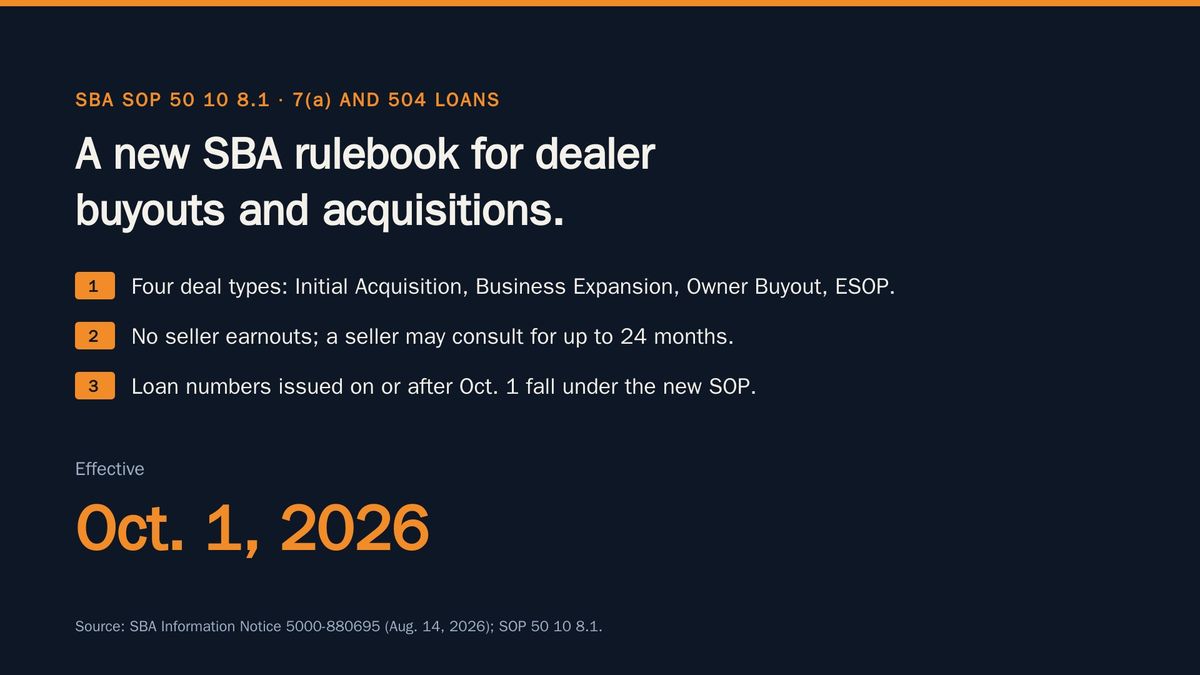
Appendix 15 of the new SOP sorts every change-of-ownership loan into four types: Initial Acquisition, Business Expansion, Owner Buyout, and ESOP and Cooperative. For the first two types, the SOP requires an independent Quality of Earnings review once the purchase price reaches a threshold the SOP sets.
The Situation
Starting Oct. 1, 2026, a propane dealer financing the purchase of a neighboring company, or a buyout of a partner, with an SBA loan will face a new rulebook. According to SBA Information Notice 5000-880695, published Aug. 14, 2026, SOP 50 10 8.1 governs every 7(a) and 504 application that receives an SBA loan number on or after that date. The same notice says applications submitted through Sept. 30, 2026 stay under the older SOP 50 10 8.0. Timing matters here. Two otherwise identical deals can land under different underwriting standards depending on when the lender gets the loan number.
The Facts
Under Appendix 15, a deal counts as a Business Expansion when three conditions are met. The buyer must have operated for at least two full fiscal years under its current ownership. It must purchase 100% of the target. The target must sit in the same four-digit NAICS industry group as the buyer. The SOP adds that the deal must leave the business with at least as many full personal guarantors as it had before closing. On debt service coverage, the SOP sets 1.25:1 for Initial Acquisitions, 1.15:1 for Business Expansions and 1.25:1 for Owner Buyouts.
The SOP also sets a minimum equity injection of 10% across these categories. SBA bars any reduction for Initial Acquisitions. For Business Expansions and Owner Buyouts, a lender may cut or waive the injection if it finds the borrower has enough liquidity and working capital to keep operating after the deal. In a Business Expansion or Initial Acquisition, the SOP lets the business hire the departing seller as a consultant for up to 24 months in total. The SOP prohibits seller earnouts, though it allows buyer rebates tied to business performance. Beyond ownership changes, the National Association of Government Guaranteed Lenders (NAGGL) reports that the new SOP lets lenders refinance their own debt under delegated authority. NAGGL also says a trust with any ownership stake must now guarantee the loan, and a trustor must guarantee personally whether the trust is revocable or irrevocable.
Business Impact
The lower coverage bar for Business Expansions favors established dealers buying within their own industry group. First-time buyers get no such break. Several questions remain open. A footnote in SBA's notice says the agency is still updating its application forms. No source says how individual lenders will apply the new rules, or how long a QoE review will take or what it will cost. The SOP never mentions propane. Whether a particular target shares your four-digit NAICS group is a question for your lender and accountant.
What this means for your business: 1. The date your loan number issues decides which rulebook applies to your deal. 2. Buying a neighbor may qualify for looser coverage and equity terms than a startup buyer would get. 3. Earnout-style seller financing has to be restructured before you apply. 4. A seller who plans to stay on long term will need a different arrangement.
Key Data Points
- Owner Buyout and ESOP deals skip the QoE requirement, according to the SOP, because existing owners keep operational knowledge and management stays the same.
- Where a QoE is required, the SOP calls for it in addition to the standard business valuation.
- Except for a consulting contract, the SOP says the seller in a Business Expansion or Initial Acquisition may not stay on as an officer, director, stockholder or employee.
- ESOP and Cooperative deals carry a 1.25:1 coverage requirement under the new SOP.
- SBA's notice says that until new forms arrive, lenders must collect the required information and certifications under both the existing forms and the new SOP, and keep them in the loan file.
Key Takeaways
- Assume your deal is an Initial Acquisition until your lender documents otherwise, because the SOP makes that the default category.
- Expect your lender to explain in its credit memo why your deal qualifies as a Business Expansion or Owner Buyout.
- Measure the QoE threshold on the full purchase price, since the SOP applies it before buyer equity, seller debt or other financing.
- Ask whether coverage will be tested on your last fiscal year or a two-year average, on a historical or adjusted basis, since the SOP permits each.
Action Steps
- 1.If a purchase or partner buyout is in talks, ask your SBA lender whether the loan number will issue before or after Oct. 1, 2026.
- 2.Have your accountant confirm that the target's NAICS code shares the first four digits with yours before you count on Business Expansion terms.
- 3.Replace any earnout in a draft term sheet with a structure your lender confirms is allowed, and limit any seller transition role to consulting.
- 4.Pull three years of tax returns, bank statements and monthly financials for the target now, because a Quality of Earnings review reconciles those records.
Competitive Advantage
Dealers who line up clean target financials and confirm industry-group fit early can move quickly when a neighbor decides to sell. Sellers tend to favor buyers who can close. A buyer already prepared for the QoE review and cleared on equity terms can offer that certainty. Confirm every term with your lender before you commit.
If a neighboring dealer called tomorrow ready to sell, could you hand your lender three years of clean records on that business?
Get the next one in your inbox.
Free propane industry news, twice a week. 30,000+ operators already read it.
No spam, unsubscribe anytime. We'll email you a link to confirm — that's how we keep the list real. Cloudflare processes a short bot-check token on this form. See our privacy policy.
Published by PropaneInsider.com
AI-powered propane industry news for 30,000+ professionals
Propane Insider is published by the makers of Tank Spotter, Custom Fuel App, Blink Fuel, PIMS and Propane Safety Pro; some links go to advertisers.