
Bobtail or Box Truck: Who Pays for a Vendor’s Propane Education
Who Pays for a Vendor’s Propane Education
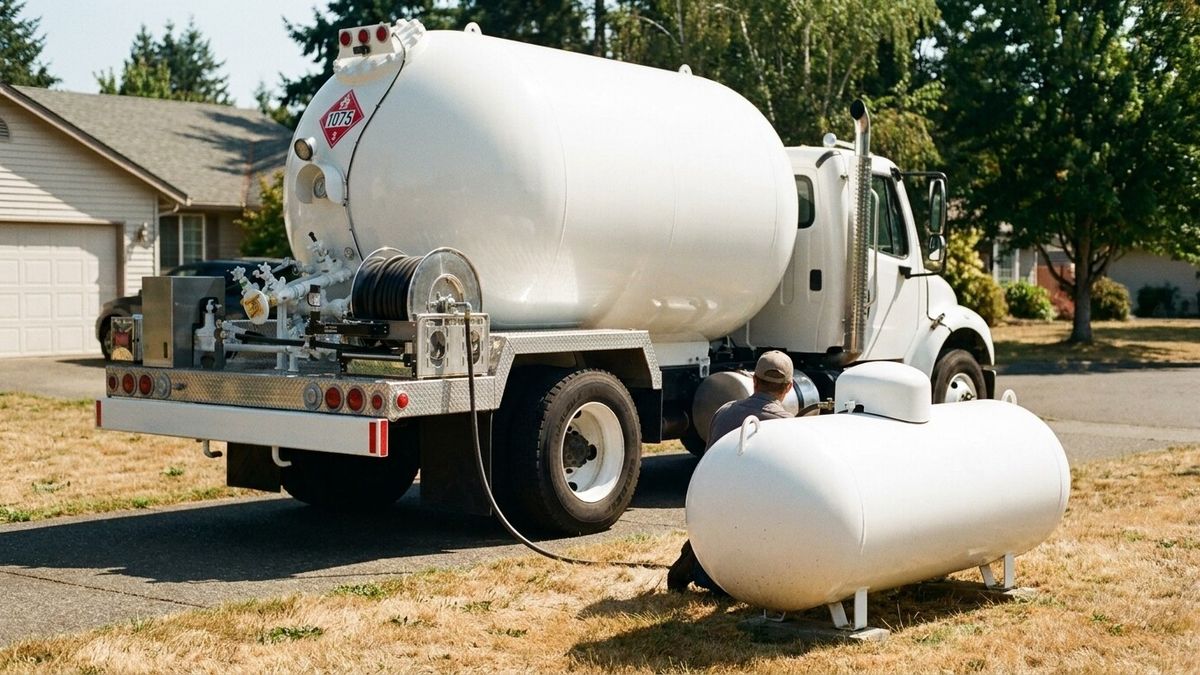
Every dealer who hires outside marketing help makes a second choice inside the first: who pays for the vendor’s propane education. A generalist’s tuition shows up as revision rounds, box-truck photos on propane homepages, campaigns bought for towns nobody delivers to, and confident claims nobody in the room was qualified to check. Five questions sort the field in the first meeting.
The Situation
On July 20, 2020, the Occupational Safety and Health Administration's Directorate of Enforcement Programs answered a letter from Falicia Hill, director of safety programs at American Tower Corporation. Her question was narrow and entirely practical. An aboveground LP-gas container sits near a building. Two authorities appear to give two different answers about the distance between them. Which one governs?
OSHA restated the question in its own words. Hill had "requested an interpretation regarding a possible conflict on the minimum separation distance between aboveground liquefied petroleum gas (LPG) containers and buildings in OSHA's 29 CFR § 1910.110 – Storage and Handling of Liquefied Petroleum Gas Standard, and National Fire Protection Association (NFPA) 58 – Liquefied Petroleum Gas Code (2017 Edition)."
One tank. Two documents. A career safety professional who needed a federal agency to tell her which to follow.
That is the ground under this business. It is also the ground an outside marketing vendor walks onto the morning a dealer hands over the website, the customer list, the Google profile, and the truck photos.
The Facts
The decision inside the decision
Every retailer who hires outside marketing help is making a second choice buried in the first one: who pays for the vendor's propane education, and in what currency.
A shop that already works in this industry produces something usable by the second meeting. A generalist produces something usable sometime in the second quarter, after the owner has spent months explaining the business one correction at a time — usually in the evening, usually after a delivery day, usually to a project manager who is taking notes on a trade they will forget the week the contract ends.
That tuition gets paid in calendar time rather than as a line on an invoice. Which is exactly why it disappears from the comparison when two proposals are sitting side by side on the desk.
What the vocabulary gap costs
Start with two words that sound interchangeable to anyone outside the business: will-call and keep-full.
A vendor who treats them as synonyms writes a polished retention email asking keep-full customers to please call when the gauge gets low. Those customers signed up specifically so they would never have to look at the gauge. The message tells them their supplier has lost track of which program they are on. Nobody replies. Nobody complains either, so the dealer sees a flat open rate and never learns why the campaign went nowhere.
The same gap runs through the photography. A bobtail is a purpose-built delivery truck — mounted tank, meter, reel, hose. Box trucks, fuel-oil trucks and water trucks all get quietly dropped onto propane dealer homepages by designers pulling from a stock library and searching the word "fuel." Homeowners may never notice. Drivers notice in a half second, and so does every competitor in the county.
Tank ownership moves the whole offer. A customer on a leased tank faces a switching cost. A customer who owns the tank outright can change suppliers with one phone call. Those are two different win-back campaigns and two different price conversations, and a marketer who cannot tell the segments apart ends up writing to neither.
Then there is geography. Route economics hold most residential delivery inside roughly a 30- to 35-mile ring around each yard, stretched along highway corridors and cut short by mountains, water and city limits. A generalist buys the metro. Spend lands on households the dealer cannot profitably serve, the leads that come back have to be disqualified by ZIP code by whoever answers the phone, and the monthly report shows lead volume climbing while gallons sit still.
Where ignorance turns into exposure
Propane marketing runs closer to regulated speech than most consumer categories, and a vendor who has never felt that will write straight through it.
The Federal Trade Commission states the baseline plainly in its advertising guide for small business: "Advertising must be truthful and non-deceptive; Advertisers must have evidence to back up their claims; and Advertisements cannot be unfair." The same FTC guidance notes that the agency "looks at both 'express' and 'implied' claims," which means the headline a copywriter thought was a mood can be read as a promise.
Now put that against a phrase a generalist reaches for on instinct: the safest propane delivery in the county. Read literally, that is a comparative safety claim about a hazardous material. Somebody has to be able to back it up, and the file belongs to the dealer whose name is on the page, not to the copywriter who typed the line.
Cylinder language carries a similar trap. The yard says "recert." The federal rule uses a different word and is specific about who may use it: under 49 CFR 180.205(b), "No person may represent that a repair or requalification of a cylinder has been performed in accordance with the requirements in this subchapter unless that person holds a current approval issued under the procedural requirements prescribed in subpart I of part 107 of this chapter." A website is a representation. A vendor fluent in this industry writes around that without being asked. A vendor who is not hands the dealer a page of confident sentences and no idea which of them needed a lawyer's eye.
Hiring in-house does not route around it
Bringing the work inside capitalizes the education cost rather than eliminating it. A salary buys marketing competence. It does not come with a candidate who has ridden a route in January, and in the small towns where most independents operate, that candidate is usually not in the applicant pool at any wage. Whoever gets hired learns propane from the owner, on the same evenings, one correction at a time.
So the education gets paid either way. The only variable a dealer actually controls is whether they are paying for it a second time, after somebody else already covered the first bill.
Five questions that sort the field
Ask for the propane client list by name, then ask to see the work — not a logo wall. The city pages. The delivery-notification email. The Google Business Profile posts. Domain fluency shows up in nouns, and nouns are visible on a screen in about ninety seconds.
Hand them a draft with a safety superlative buried in the middle of it. A shop that has worked this industry stops on it unprompted and asks who can substantiate it. A shop that hasn't compliments the headline.
Ask who reviews their copy for regulatory language, and what happens when a claim touches cylinders, equipment or installation. The answers vary by shop size. What separates them is whether there is a process at all, or whether the question is landing for the first time.
Call two dealer references and ask one unglamorous thing: how many revision rounds did the first three deliverables take, and what were the corrections about? Typos are routine. Corrections about how the business works are the education bill, itemized by an operator who already paid it.
The fifth question is free, and the dealer never has to ask it. Before proposing a page-per-city program or a regional ad buy, a competent vendor should want to know how many yards the company runs and where they sit. A shop that skips straight past that is about to build a campaign for towns nobody delivers to.
The tell tends to arrive in the first meeting. A vendor who asks about yard locations and delivery radius before asking about the logo has already answered the most expensive question on the list. The other kind gets there eventually — on the dealer's clock, at the dealer's rate, and with the invoice arriving the whole time.
Reader action: Before your next marketing vendor call, write down three questions from this article — their propane client list, who reviews their copy for claim language, and how their city-page or ad-radius plan accounts for your yard locations. Ask all three in the first meeting, and note which ones the vendor has clearly answered before.
Before your next marketing vendor call, ask three questions from this article — their propane client list, who reviews their copy for claim language, and how their city-page or ad-radius plan accounts for your yard locations.
Get the next one in your inbox.
Free propane industry news, twice a week. 30,000+ operators already read it.
No spam, unsubscribe anytime. We'll email you a link to confirm — that's how we keep the list real. Cloudflare processes a short bot-check token on this form. See our privacy policy.
Published by PropaneInsider.com
AI-powered propane industry news for 30,000+ professionals
Propane Insider is published by the makers of Tank Spotter, Custom Fuel App, Blink Fuel, PIMS and Propane Safety Pro; some links go to advertisers.