
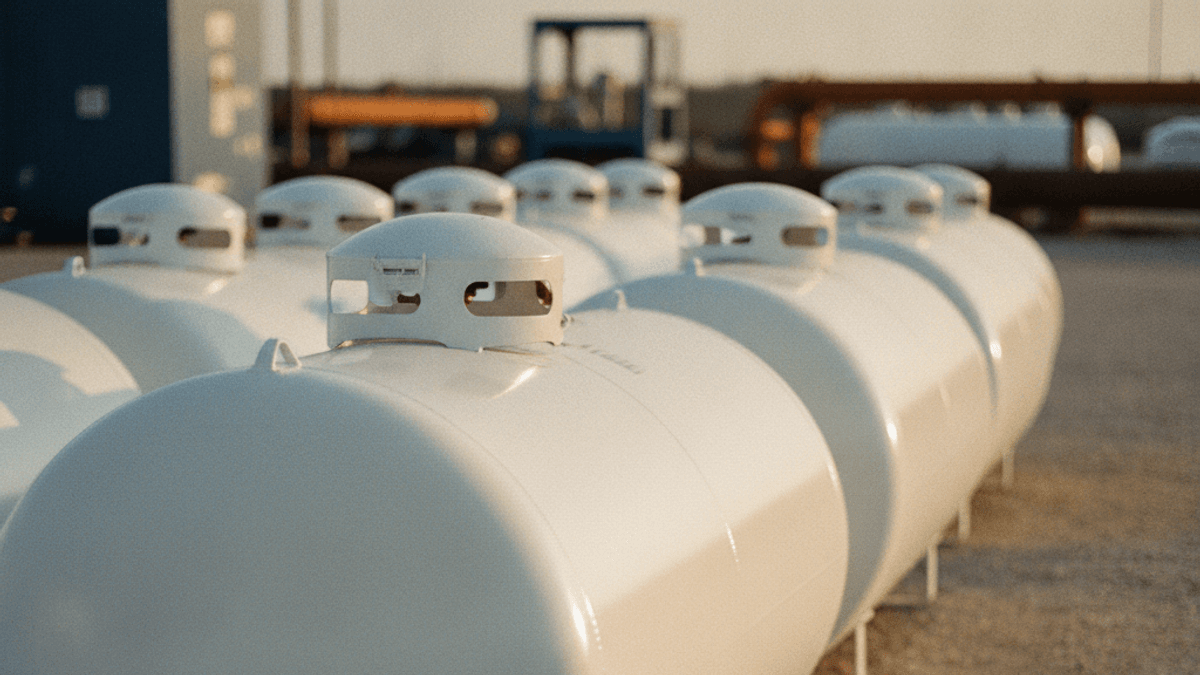
Every propane retailer knows where the money in this business is really locked up: you win the gas account by owning the storage. The tank you set in a customer's yard is the most expensive part of winning that account, and on the balance sheet it is also one of the most valuable things you own. So when the federal government changes what a steel vessel costs to land at the dock, it changes the economics of growing a route, even when the same gallons move as before.
That is roughly what happened this spring, and it arrived with almost no fanfare in the propane press. A revision to the Section 232 metals tariffs took effect April 6, 2026, and for once the fine print names our equipment directly. The headline rate is the import duty on the steel vessel itself, and the sections below walk through what past tariff rounds actually did to the price a dealer pays for a tank.
What changed on April 6
The change was more reshuffle than simple hike. According to trade-advisory firm C.H. Robinson, whose client advisory laid out the mechanics, the April rule sorts metal goods into cleaner buckets and drops the old practice of taxing only the metal portion of an item. The firm reports that duties now apply to the entire customs value of a covered article, regardless of actual metal content — so an imported steel vessel is taxed on its whole delivered price, not a sliver of it.
The rates split by how much metal an item carries. C.H. Robinson reports that a 50% duty applies to steel and most steel-derived goods named in Annex 1-A of the proclamation, while derivative articles the firm says are more than 15% metal by weight pay a flat 25% of full value; goods below that metal threshold drop out of Section 232 entirely.
The detail that matters for this industry sits in the annex. Trade coverage of the update — the Trending in Propane summary of the industry's Bobtail tariff bulletin — flags that the proclamation's Annex 1-A lists Heading 7311, "Containers for compressed or liquefied gas, of iron or steel," and the aluminum equivalent alongside it, the tariff codes for propane tanks and cylinders. The proclamation names our core asset directly rather than catching it as a derivative of something else, and it places these containers in the top-rate category.
Why propane feels this more than most
The tariff reaches propane through its equipment rather than its fuel. The same tariff schedule places liquefied propane in a separate annex that carries no Section 232 metals duty, so the gas itself lands at the same cost it did last year. The added cost falls on the hardware: tanks, valves, regulators, cylinders, and the bobtails that haul the product.
That is a heavier burden for propane than for many trades because of how the industry finances a customer. In the dominant company-owned-tank model, the retailer buys the ASME tank, sets it, and recovers the cost slowly over years of deliveries. The tank is a multi-year bet on keeping the account. When the price of that steel vessel jumps, the capital you lay out before the first fill jumps with it — and you cannot pass a tariff through on a tank you are lending to the customer the way you might reprice a gallon.
It also reaches the value of the company itself. Writing in Butane-Propane News, valuation consultant Steve Abbate notes that in propane-brokerage math the percentage of company-owned tanks — "tank control" — is a headline value driver, right alongside fleet age and real estate. A route thick with owned tanks commands a stronger multiple. Growing that book now costs more per tank than it did a year ago, a subtle tax on the very thing buyers pay up for.
Operators have run this play before
This is not a first encounter, and the last two rounds are a useful gauge. When the original Section 232 steel tariffs hit in 2018, tank broker Alliance Truck & Tank reported that propane tank prices rose 20-25%, with delivery timelines stretching as material tightened — a figure later cited by succession-planning firm The Rawls Group. Manufacturers pay more for raw material and pass it down the chain, and the squeeze, the firm said, falls hardest on the small and mid-sized dealers with the least room to negotiate.
The 2021-22 run showed how ugly the second-order effects get. Writing in Butane-Propane News in April 2022, Steve Abbate of Cetane Associates reported that the more popular tank sizes were up more than 80% from two years prior, while wait times for truckloads ran beyond a year in some locations. He tied that squeeze directly to company value, and said his worked illustration starts with a company that once cleared $1 million of EBITDA, then watches a growing share of that cash get consumed by capital spending as per-unit equipment costs climb — so the money the business actually throws off shrinks even when revenue holds.
The lesson operators drew last time was defensive and practical: track down every unused tank in the yard before buying new, and hold trucks longer than the old replacement schedule suggested. Both moves are back on the table.
The real cost is planning in the dark
Beyond the rate, the harder tax this cycle is uncertainty. Broader U.S. trade policy remains legally contested and fast-moving, and that churn has its own price. Supply executives interviewed for Butane-Propane News's 2026-27 outlook described the difficulty of planning against a moving target: the constant change piles onto administrative expense — policy tracking, cost estimating, re-quoting — and complicates any attempt to lock a landed equipment cost a year out.
For a propane retailer, capital planning is the whole game in the shoulder season. Tank buys, truck orders, and yard builds are placed months ahead of the heating season they serve. A moving tariff turns a routine purchase order into a bet on where policy lands by delivery date, and long manufacturing lead times mean a wrong guess is not easily unwound.
What operators are doing about it
None of this argues for freezing growth; it argues for sharpening the pencil. The tactics circulating among dealers and their advisors are unglamorous and, mostly, things a well-run shop already half does:
- Inventory the yard first. Every serviceable tank recovered, repainted, and re-set is a tank not bought at a tariffed price — provided any reconditioned ASME container is installed and inspected for continued suitability in accordance with NFPA 58 and any requirements of your authority having jurisdiction before it goes back in the ground.
- Lock landed costs where you can. Firm quotes and longer-dated supply agreements with equipment vendors convert a moving target into a fixed line.
- Diversify who you buy from. A single supplier is a single point of failure when lead times blow out; more than one relationship keeps a delayed order from stranding a fall install.
- Treat tank control as the asset it is. If owned tanks now cost more to place, the ones already in the ground are worth defending through service and swap-back discipline.
So before the next buying season, sit down with your own numbers and run the short version of this yourself. Walk through the yard and count the idle tanks you could recondition instead of buying new. Pull up your last equipment invoices and check which line items are steel. Ask each vendor to put a firm landed price and lead time in writing, and reach out to your state propane association for the latest read on where the rules stand. Then bring those answers to your team and decide how many tanks you can afford to set this year — because for 2026, the operators who come out ahead will be the ones who counted the steel before they counted the gallons.