
The 9 P.M. Propane Order Your Phone Line Never Hears
The 9 P.M. Propane Order Your Phone Line Never Hears
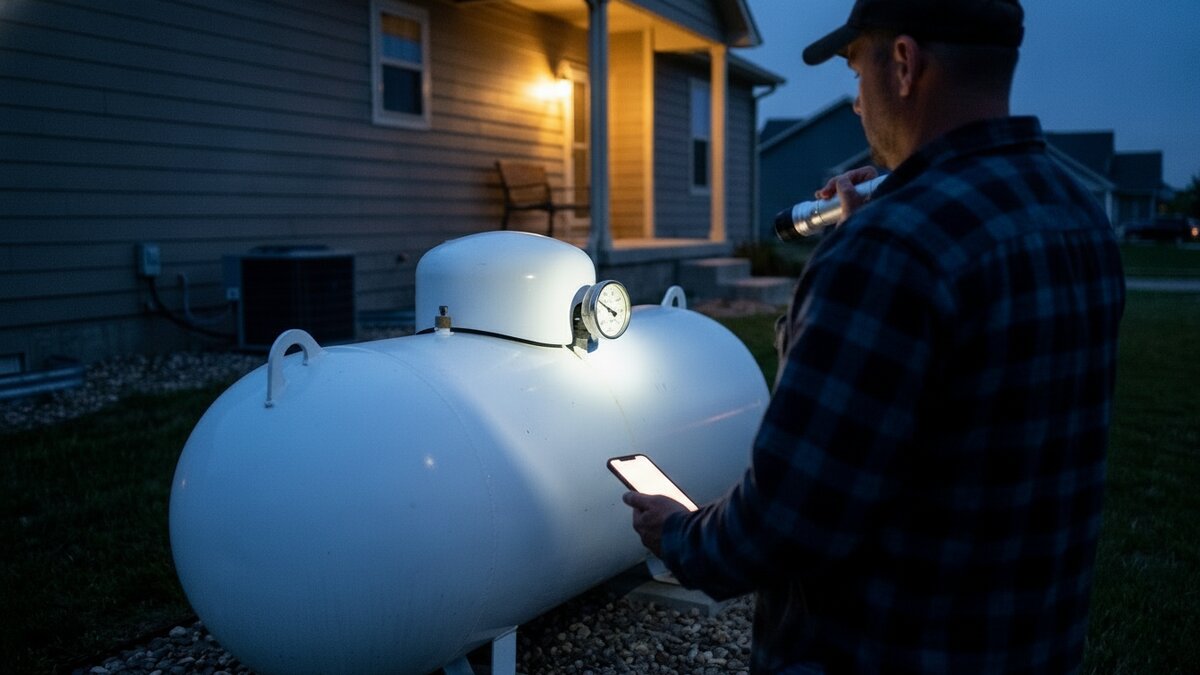
Gauge-checking is an evening activity, and the moment of highest customer intent lands almost entirely outside staffed hours. Nine in ten American adults carry a smartphone, and screens keep taking a larger share of retail buying every quarter. The case for a dealer ordering app is arithmetic — and the feature list that makes one work is specific: one-tap reorder, a service-area check up front, payment on file, visible delivery status.
The Situation
Consider the generic version of a transaction every propane dealer has run a thousand times. No names here, no single company — just the shape of the business.
Thursday in November, a little after nine. A customer walks out to the tank with a flashlight, reads the gauge, doesn't like the number, and goes back inside to call. The office closed at five. She gets the after-hours greeting, which routes true emergencies to a pager and everything else to a callback queue. She leaves her name, spells her street twice, and guesses at her account number.
Friday morning a CSR plays the message, searches the name, finds two of them, picks the right one, and calls back. Voicemail. The customer calls the office herself at two in the afternoon from her car. They reconfirm the address. The CSR asks how she'd like to pay, and the customer reads sixteen digits out loud in a parking lot. The fill goes on next week's route.
Nothing in that sequence is broken. It simply took two employees, three phone calls and roughly seventeen hours to process an order the customer had fully decided on the night before, standing in her own driveway.
The Facts
The comparison she is already making
Every part of that lag traces back to the telephone, which for most of a century was the fastest thing available to anybody. What has changed is the yardstick the customer holds while she's standing at the tank.
She refilled a prescription that morning with two taps. Her bank moved money between accounts while she sat at a light. According to Pew Research Center's Mobile Fact Sheet published Nov. 20, 2025, ninety-one percent of U.S. adults own a smartphone — up from 35% when the Center first measured smartphone ownership in 2011.
The buying habit moved with the hardware. E-commerce accounted for 16.9% of total U.S. retail sales in the first quarter of 2026, the Census Bureau reported on May 18, 2026, and that channel grew 9.8% year over year while total retail sales grew 3.9%. The gap between those two growth rates is the part worth sitting with. Screens keep taking a larger share of American buying every quarter, and the people doing that buying are the same people reading propane gauges in the dark.
After hours is where the orders are
The strongest case for a customer ordering app rests on arithmetic rather than on anybody's taste in technology.
Call it 45 staffed hours a week on the phone line. That leaves 123 hours in which a customer's decision has nowhere to go but a voicemail box. Gauge-checking is an evening activity. So is bill-paying, and Sunday-morning worrying about whether there's enough propane to get through a cold snap. The moment of highest intent in the whole relationship — the moment the customer has decided to buy — lands almost entirely outside business hours during the months that matter most.
A dealer with no digital intake doesn't lose all of those orders. Most customers will call back. But some fraction won't, and the dealer never sees the ones that didn't, which is exactly why the number is so easy to leave unexamined.
What a good ordering app actually does
The generic answer is "let customers order." The useful answer is more granular, and the granularity is where these things succeed or fail.
Reorder in one tap. The app already knows the account, the service address, the tank, and what the last delivery looked like. "Same as last time" is the entire feature. Hand a returning customer a blank address field and you have built a form, which she already had.
A service-area check before the form, not after. ZIP validation should fire the second the customer types it, so an out-of-area prospect gets a straight answer immediately instead of a rejection call two days later. Route economics put most single-yard dealers around a 30-to-35-mile working radius, though highways, county lines and terrain stretch that in real service areas.
Payment already on file. Nobody reads a card number into a phone. Worth being precise about the limits here: a propane ordering app does not function as a retail checkout, and delivered gallons are priced and billed on the dealer's normal cycle. What the app removes is the card-reading, the mailed check and the "did you get my payment" call.
Delivery status the customer can see. The most common inbound call after an order is placed is some version of "is it coming today?" A status line that answers that question retires the call.
Tank level and delivery history. Gallons and dates from prior fills, plus a way for the customer to photograph the gauge so a dispatcher can see what she's seeing. History is also the quiet argument for automatic delivery: a customer looking at her own consumption pattern is the easiest customer to enroll.
A notification that surfaces. A push alert lands on a lock screen. An email about a low tank lands in a folder the customer opens on Sunday, if then.
One more feature costs nothing and pays the most: offering automatic-delivery enrollment at the moment the customer places a will-call order. That is the highest-intent second in the entire cycle, and the pitch writes itself from the customer's side — enroll, and stop thinking about the gauge.
Where the taps get lost
The failure mode is rarely the app itself. Almost always it is what happens in the ninety seconds after the tap.
An order has to land in the dealer's existing queue, matched to the right account, in the same place the CSR already looks. An app that dumps requests into a shared email inbox has recreated the voicemail problem with better graphics. Someone has to own that queue on a Saturday, or the 9 p.m. order still waits until Monday and the customer learns the app is decorative.
Confirmation matters as much as intake. The customer needs to see that the order was received and roughly when to expect the truck. Without that, she calls the office to make sure it went through, and now the dealer is running an app and a phone call.
There is also a real choice in form factor. A native app that installs on the phone gets home-screen presence and push notifications, and it asks the customer to download something first. A mobile-friendly order form on the dealer's website asks for no install and works for a stranger who arrived from a search result. Those serve different customers at different moments, and plenty of dealers end up running both.
The customers everyone assumes won't use it
The standing objection is that propane customers are older and rural and won't touch an app. Some won't. But 96% of U.S. adults use the internet, per Pew Research Center's Internet, Broadband Fact Sheet published Nov. 20, 2025, and the retired schoolteacher on a five-hundred-gallon tank has been video-calling grandchildren for a decade.
Rural connectivity is genuinely uneven, which makes it a design constraint to work inside. The app has to hold up on one bar of signal and on a five-year-old phone. Type has to be legible without reading glasses. And the phone line stays open, staffed and answered. The app adds a lane.
What a dealer can measure this week
Pull last month's inbound call log and count how many calls were nothing but a reorder — no billing question, no service issue, no complaint attached. Then count the after-hours voicemails, and mark how many turned into a delivery and how many went cold. Those two numbers describe what a digital ordering lane is worth in one specific operation, and they can be counted before anyone talks to a vendor.
Customers grade the ordering experience against the last app they opened that day: the pharmacy, the bank, the hardware store that texted a pickup code. Those companies sell no propane and never will, and they are still the ones setting the bar the gauge-reader is holding at 9 p.m., when she decides whether to leave a voicemail or go looking for a supplier who lets her tap.
RESOURCE — FROM PROPANE INSIDER
Custom Fuel App builds the customer-facing ordering app under the dealer's own name, logo and colors. Customers see the dealer's brand in the App Store and on their home screen. One-tap delivery requests, tank-gauge photo capture, autopay enrollment and payment history, push notifications for low-tank alerts, and a message inbox that takes non-urgent customer contact out of the phone queue. On the operator side: customer roster, payment history, a push scheduler and an admin dashboard.
The dealer supplies a logo, brand colors, a hero photo and a feature priority list. Design, back-end integration and both store submissions are handled on our end. A typical build runs about four weeks from kickoff to live in the App Store and Google Play, with no developer required on the dealer's side.
customfuelapp.com · Schedule a walkthrough: customfuelapp.com/demo
Pull last month’s call log: how many inbound calls were nothing but a reorder, and how many after-hours voicemails went cold?
Get the next one in your inbox.
Free propane industry news, twice a week. 30,000+ operators already read it.
No spam, unsubscribe anytime. We'll email you a link to confirm — that's how we keep the list real. Cloudflare processes a short bot-check token on this form. See our privacy policy.
Published by PropaneInsider.com
AI-powered propane industry news for 30,000+ professionals
Propane Insider is published by the makers of Tank Spotter, Custom Fuel App, Blink Fuel, PIMS and Propane Safety Pro; some links go to advertisers.